

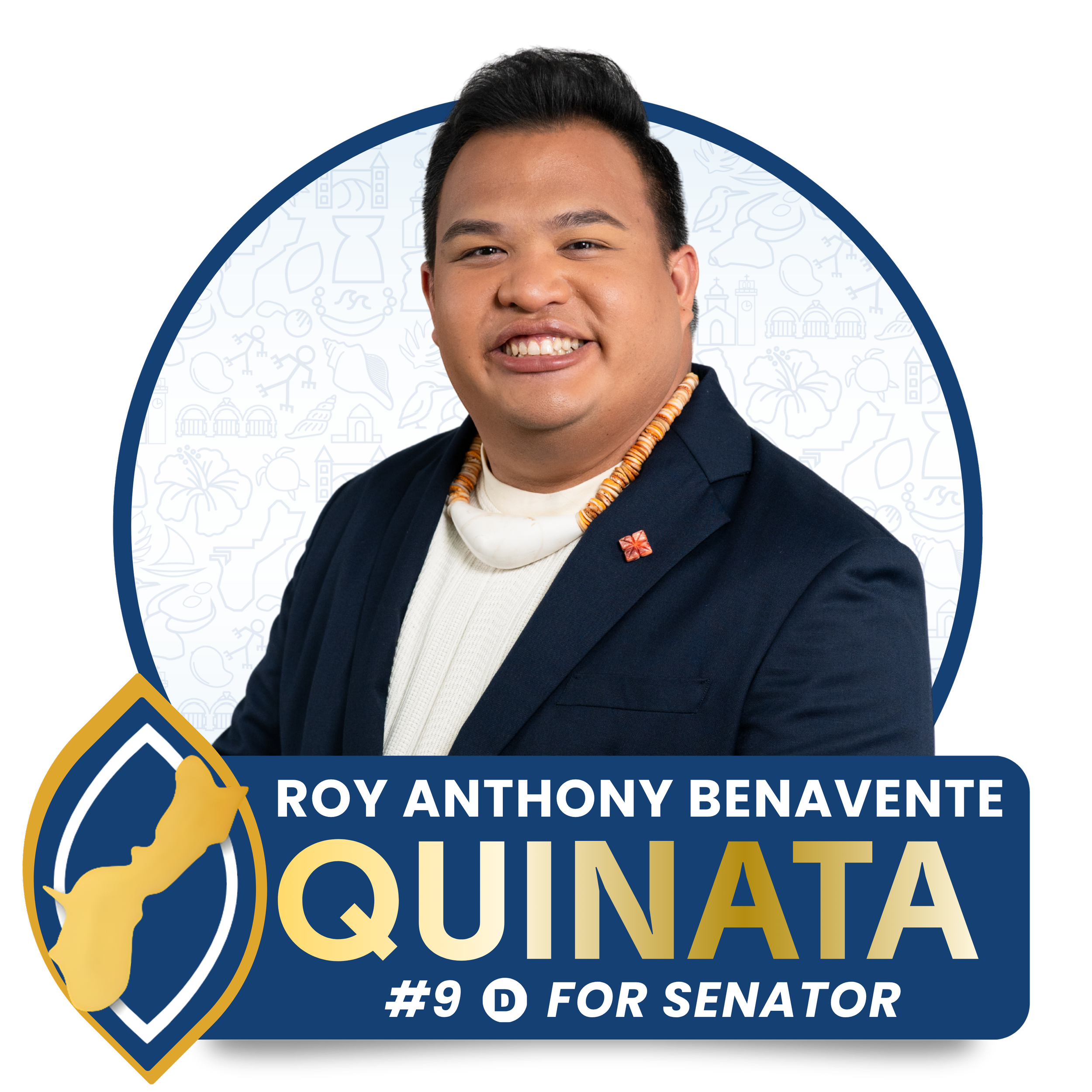
As leaders, it’s imperative that we work towards improving the quality of life and ensuring the next generation inherits opportunities over obstacles. Let’s move Guam Forward Together.
My Mission in the
39th Guam Legislature
-
Ensuring the Next Generation Inherits Opportunity, Not Obstacles
Roy believes in creating a stable, equitable environment where local entrepreneurs flourish alongside the island's evolving infrastructure.Championing Investment: Legislating policy that responds to long-term stability by streamlining government services and more digitally friendly.
Workforce Success: Advocates for a living wage and specialized "boot camps" for trades like welding, 3D solution printing and cyber advancement, ensuring our people have the skills to thrive in a modern economy.
Modernizing Interaction: Pushing to reduce "red tape" through electronic reporting mandates, making it easier for local entrepreneurs to start and grow businesses.
-
Modern Facilities for High-Quality Learning
Drawing on his experience managing capital improvement initiatives at Adelup, Roy is committed to modernizing school infrastructure to provide safe, conducive learning spaces.
Modernizing Schools: Leading the effort to rebuild Simon Sanchez High School and securing millions in funding for essential school repairs.
Fixing Maintenance: Proposed specialized, regional maintenance teams to bypass procurement delays and keep facilities open and safe for students.
Elevating UOG: Pushing to establish a Federally Funded Research and Development Center (FFRDC) at the University of Guam to position Guam as a regional intellectual hub.
Advancing more educational opportunities with charter schools through military partnerships and international schools.
Increasing financial support for students to be 1st in the job market and not 2nd.
-
Moving Beyond "Band-Aid" Approaches - We need to be building our workforce and pay better.
Rather than temporary fixes, Roy is mapping out Guam-specific rules that address our unique labor and community needs for the long term.
Enduring Solutions: Initiating discussions with stakeholders to address Guam’s unique immigration challenges, ensuring we can recruit essential healthcare professionals while building local capacity.
Expanding Connections: Advocating for the expansion of the visa waiver program to the Philippines to support Guam’s tourism economy and help families maintain vital ties.
-
Dignity in Aging, Autonomy in Health, and Spaces for Community
The strength of our island is found in how we care for our elders and protect the fundamental rights of our families. Roy’s vision ensures that healthcare remains a private matter and that our Manå’ina have the resources to age with grace, safety, and independence.
SSI Equality for Guam: Roy will aggressively pursue Supplemental Security Income (SSI) for Guam residents. By advocating to "delink" Guam from Puerto Rico in federal legal strategies, we can fast-track the financial support our seniors and people with disabilities have earned as American citizens.
A "Continuum of Care" Model: No senior should be forced into a facility before they are ready. Roy will legislate the expansion of Adult Day Care and In-Home Support Services, providing families with the respite and professional help they need to keep their Manå’ina at home longer.
Protecting Healthcare Autonomy: Roy believes that life-altering medical decisions belong to individuals and their doctors, not politicians. He stands as an unwavering advocate for reproductive freedom, ensuring every woman has the right to make her own healthcare choices with dignity and privacy.
Revitalizing Community Spaces: Our parks should be the "living rooms" of our villages. Roy will shift park management from "annual cleanups" to Year-Round Maintenance Mandates. By securing operational facilities and lighting, we turn neglected lots into safe, vibrant hubs for family engagement and youth sports.
Putting "SIN Tax" Dollars to Work: The community shouldn't have to wonder where their tax dollars go. Roy will push for Strict Accountability of the SIN Tax Special Funds, mandating that these revenues are used exclusively for their intended purposes: modernizing multi-purpose community centers and expanding health services.
-
Building Back Better for Community Resilience
True growth comes from infrastructure that supports the next generation's ability to live, work, and stay on-island.
Resilient Infrastructure: We need to invest in infrastructure that leads to better roads. While we plan for reconstruction and safety projects, such as the improvements to our secondary roads, to enhance island-wide connectivity and smoother transitions.
Homeownership Support: Proposing housing programs for middle-class families so the next generation can afford to build their futures here on Guam. Our working class people shouldn't have to work (3) jobs to rent a decent dwelling when they should invest in a home.
Sustainable Recovery: Leveraging experience from Typhoon Mawar to build sustainable community infrastructure that protects our economy and families from future challenges.
We know our resources during disasters are scarce and we need to stand ready for them, by having the heavy equipment ready for mayors to use and have a stock pile of local response.
Increasing the use of solar street light integration for roadside use.
Legislate the use of traffic cameras
9-1-1 integration and update for the 21st century and also pushing for (3) rapid response for disaster readiness.
Breaking the Gridlock: A Modern Procurement System for Guam
Moving from a culture of "No" to a culture of "Go." Tulos Mona’
We will stop the "automatic stay" from paralyzing our island. By modernizing the law, we ensure that tax dollars translate into finished projects—not endless court dates.
Accountability Through Transparency: The 21st Century Portal: We will launch a Centralized e-Procurement Hub. Every solicitation, contract award, and protest status will be searchable online in real-time. No more "lost" files or closed-door decisions.
Digital One-Stop Permitting: We’re moving the One-Stop Center online. You should be able to track your permit status from your phone, eliminating the "paper trail" delays that stall local entrepreneurs.
Quality Over Lowest Price: Defining "Best Value": We will redefine procurement law so the government isn't forced to buy the cheapest, lowest-quality product. We will prioritize Value & Durability, ensuring our infrastructure lasts for the next generation, not just the next fiscal year.
Ending Frivolous Delays: "Skin in the Game": To stop "frivolous protests" meant only to block competitors, we will implement Protest Filing Fees and Cash Bonding requirements. If a protest is legitimate, the money is returned; if it's a delay tactic, those funds go back into the community.
Firm Deadlines: No more "dragging on." We will mandate a 21-day resolution window for agency-level protests. If the government can’t decide, the project moves forward.
Proactive Legal Oversight: In-House Legal Experts: We will place dedicated legal counsel directly within procurement agencies to "protest-proof" contracts before they are signed. By getting it right the first time, we avoid the lawsuits that cost us millions in the long run.
Mediation First: Before a case hits the courts, we will mandate Alternative Dispute Resolution (ADR). We will sit vendors down at the table to find a solution that keeps the project on track.
-
The true measure of our success is whether the next generation can afford to build a life here, or if they are forced to find a home elsewhere. Roy believes that a stable home is the foundation of a strong family and a resilient economy. We must move beyond temporary rental assistance and toward permanent homeownership.
The "Middle-Class Gap" Initiative: Current programs often leave out those who work 40+ hours a week but don't qualify for low-income assistance. Roy will legislate Down-Payment Assistance Grants specifically for first-time homeowners in the "missing middle"—our teachers, nurses, and first responders.
Cutting the "Cost of Construction": High permit fees and long wait times drive up the price of a new home before the first stone is laid. Roy proposes a "Fast-Track Housing" mandate at the One-Stop Center for local residential builds, reducing the carrying costs for families trying to build on their own land.
Modernizing Land Use & ADUs: To increase density without destroying our village character, Roy supports expanding Accessory Dwelling Unit (ADU) incentives. By allowing families to build "in-law suites" or small rentals on existing lots, we create immediate housing supply and a new revenue stream for local homeowners.
Infrastructure-First Development: We cannot build houses where there are no pipes. Roy will push to prioritize Sewer and Water Expansion in high-growth areas, unlocking hundreds of acres of family-owned land that is currently undevelopable due to strict septic regulations.
Revitalizing Abandoned Properties: Guam’s villages are dotted with "ghost houses"—abandoned or probate-locked properties. Roy will introduce legislation to streamline the rehabilitation of distressed properties, providing tax credits to locals who buy and fix up blighted homes, turning eyesores into affordable family dwellings.
Protecting Local Buyers: In a competitive market, our people are often outbid by outside investors. Roy will explore "First-Look" policies that give local residents and first-time buyers a window of exclusivity on government-subsidized housing developments before they hit the open market.
Modernizing Historical Preservation: Protecting Our Past, Not Paralyzing Our Future
From Infinite Delays to Predictable Protection
Roy believes we can honor our ancestors without leaving our children homeless. Currently, the "unknown" of SHPO clearances can add years and tens of thousands of dollars to housing projects. We must move toward a predictable, tech-forward preservation model that provides clarity for homeowners and developers alike.
The "Pre-Cleared" Housing Map: Roy will legislate the creation of a High-Resolution Archaeological Sensitivity Map. By identifying "low-impact" zones across our villages upfront, we can grant automatic or expedited clearances for residential homes in areas with no known historical significance, saving families months of waiting.
Ending the "Open-Ended" Stay: To prevent projects from sitting in limbo, Roy proposes a Mandatory Review Clock. If SHPO does not provide a determination or an on-site inspection within a 30-day window for single-family residential permits, the project should be allowed to proceed under a "certified monitor" program to keep construction moving.
A "Third-Party Certified" Roster: Much like private engineers, Roy will push to allow certified private archaeologists to conduct and sign off on initial surveys. This breaks the bottleneck at the government office and gives families the option to move their projects forward on their own timeline.
A Centralized Repatriation & Curation Center: Often, "stays" happen because there is nowhere to put significant finds. Roy supports funding a State-of-the-Art Curation Facility. By giving our artifacts a proper, permanent home, we can move items off-site faster, allowing construction to resume while ensuring our history is treated with the dignity it deserves.
The "Homeowner Hardship" Grant: For local families who discover significant artifacts on their private land, the cost of a full archaeological recovery can be ruinous. Roy will advocate for a Preservation Mitigation Fund to help cover the costs of required surveys and recoveries for first-time homeowners, ensuring the burden of history doesn't fall solely on the working class.
Thank you for the honor to serve you in the 37th Guam Legislature. I humbly ask for your vote to serve as a senator in the 39th Guam Legislature, so we can keep working to improve life on Guam. I humbly ask for one of your votes this August.
Let's measure progress instead of protest. Let's work toward a community that thrives together.
november 3rd, 2026 - general election
Key Achievements
-
Committee on Infrastructure, Economic Development, Simon Sanchez High School, Disabilities Services, Self Determination Historic Preservation, Housing, Accountability, and the Guam Buildup
-
To streamline the reconstruction of Simon Sanchez High School
The Ma Kahat Act, also known as Bill 94-37, has been approved by the 37th Guam Legislature, allowing for the progress of rebuilding and constructing Simon Sanchez High School (SSHS). Senator Roy Anthony Benavente Quinata, an SSHS alumnus, introduced the bill and received the support of all 15 members of the legislature. Senator Quinata expressed gratitude to the SSHS stakeholders and the community for their backing and active involvement in two public hearings.
The bill has integrated numerous recommended amendments gathered during the public hearings. Senator Quinata extends his appreciation to his cosponsors and the legislators who demonstrated their commitment to the educational welfare of our students by passing this crucial bill. Senator Quinata remarked, "I am grateful to everyone who supported this endeavor. It is a triumph for our students and showcases our ability to collaborate for positive change in our community."
Simon Sanchez High School holds a significant historical standing as one of Guam's oldest schools, having operated as a high school since 1981 and serving countless students. However, the school has not undergone any major renovations or upgrades since its conversion, making it one of Guam's oldest active educational facilities. The passage of this bill enables the commencement of renovation and upgrading efforts for SSHS to meet current educational standards.
The Ma Kahat Act encompasses provisions for modernizing classrooms, addressing much-needed repairs for existing buildings and infrastructure that have suffered from years of neglect due to limited funding resources. With these improvements in place, SSHS can continue its mission of providing quality education for future generations.
-
To standardize government communication as accessible for individuals with disabilities.
The Government of Guam will introduce a standardized typeface for official communications, including documents, reports, and emails. According to the United States Center for Disease Control, 1 in 4 individuals living on Guam has a disability, with 16% experiencing cognitive or visual impairments. Using an accessible font type can significantly aid those who struggle with reading text due to visual impairment or other disability-related challenges. I am committed to fostering an inclusive environment, ensuring everyone has equal access to information and opportunities.
Read Public Law 37-35 -
Secured $500,000 for rebuilding the Fisherman’s Co-op and an updated Attorney Pay Plan within the FY2024 Budget Act
An act making appropriations for the operations of the executive, legislative, and judicial branches of the government of Guam for fiscal year ending September 30, 2024, making other appropriations, and establishing miscellaneous and administrative provisions.
-
Transfers the deed for the Inalåhan Baptist Church to the Guam Preservation Trust ensuring the preservation of the church and honoring its ties to Guam’s rich history.
As your Senator, preserving our island’s culture is of utmost importance. With the enactment of Public Law 37-45, the Inalahan Baptist Church Property is now entrusted to the Guam Preservation Trust, representing a significant stride toward safeguarding our heritage. Our legislature is actively collaborating with the government of Guam, the Inalåhan Mayor, and the Municipal Planning Council to ensure the restoration and safety of Lot No. 106-1 Block No. 12, formerly known as the Inalåhan Baptist Church. This is a crucial concern for the residents and visitors of Inalåhan village. We must persist in protecting our sites to guarantee that the next generation can understand their history and reflect on their past. I express my gratitude to my colleagues for their unanimous support in the passage of this legislation. Together, we strengthen our cultural legacy and the well-being of our community.
-
To mandate government electronic reporting for greater public access.
On November 10, Governor Lou Leon Guerrero signed Public Law 37-46, which mandates electronic reporting by all GovGuam entities. This law aims to ensure transparency and accessibility to all public information.
-
Requires A.E.D.s in public acces by 2024. A.E.D.s are life saving medical devices.
By December 31, 2024, every Government of Guam office must prominently display Automated External Defibrillators (A.E.D.s). These A.E.D.s will be accessible to the public in case of emergencies. Being prepared for the unexpected is crucial. Access to this life-saving equipment might enable us to save a life.
-
Creates a low-interest home loan program for infrastructure development.
An act to authorize the Chamorro Land Trust Commission to lease all or a portion of Lot No. 7161-R1 in Yigo, Guam to the Guam Motorsports Association for the purpose of providing families with a safe and regulated space for drag racing and other on and off-road motor racing, motorbiking, and car shows and activities, and to further appropriate three hundred thousand dollars ($300,000) from the General Fund to the Chamorro Land Trust Commission for the purpose of cleaning and preparing Lot No. 7161-R1 in Yigo, for public use.
-
Would expand temporary workforce housing within M1 Light Industrial Zones.
An act to amend Section 61309, Article 3, Chapter 61, Title 21, Guam Code Annotated relative to adding temporary workforce housing as a permitted use for M1 light industrial zones.
-
Would extend Guam Driver’s License renewals to a maximum 8 years.
An act to amend § 3102 of Chapter 3, Title 16, Guam Code Annotated, relative to creating eight-year driver's licenses issued that aligns with the maximum renewal period allowed under the REAL ID Act.
-
$7M to GDOE for the construction of a Simon Sanchez High School campus.
An act to appropriate the sum of seven million dollars ($7,000,000) to the Guam Department of Education from the unappropriated and unencumbered excess FY2024 General Fund revenues to cover costs associated with the rebuilding of the Simon A. Sanchez High School campus and the leasing of a temporary campus.
-
7 Public Hearings, 3 Roundtable Hearings, 2 Informational Hearings, 1 Joint Oversight Hearing. Our Legislative Hearings covered a range of topics and provide valuable insights that shapes our policy making effort.
Roy Quinata co-sponsored 38 laws all aimed at improving life in Guam